




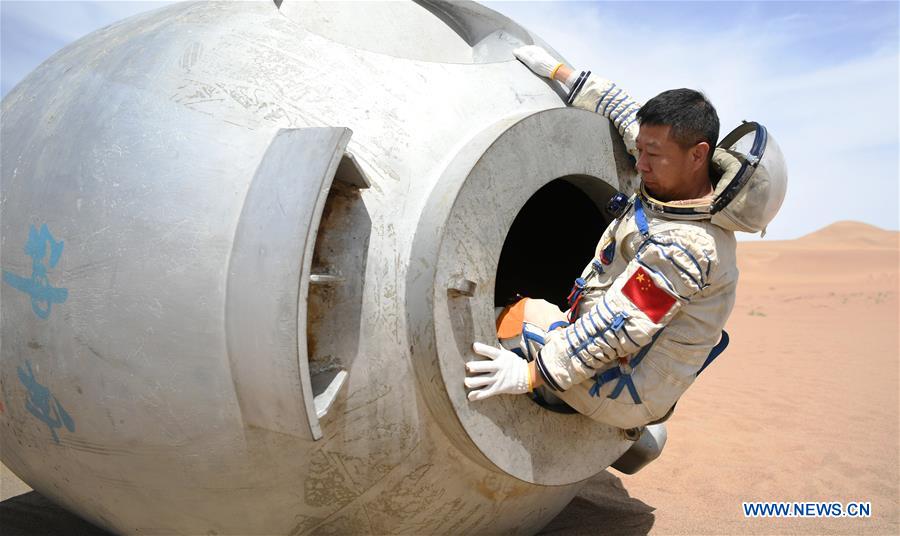
Taikonaut Liu Wang exits from a re-entry capsule during a wilderness survival training in the Badain Jaran Desert in northwest China's Gansu Province, May 17, 2018. Fifteen Chinese taikonauts have just completed desert survival training deep in the Badain Jaran Desert near Jiuquan Satellite Launch Center in northwest China. Organized by the Astronaut Center of China (ACC), the program was designed to prepare taikonauts with the capacity to survive in the wilderness in the event their re-entry capsule lands off target. (Xinhua/Chen Bin)
JIUQUAN, May 28 (Xinhua) -- The sun beat down on the endless desert as three astronauts crawled out of a re-entry capsule. One quickly retrieved a satellite phone.
"Ground control, this is mission crew. We've just landed."
"Roger. Please use what you have to keep yourselves safe. We are on our way to you."
Welcome to taikonaut training 101. Fifteen Astronaut Center of China (ACC) trainees were dropped off in the Badain Jaran Desert near Jiuquan Satellite Launch Center in northwest China and told to survive as if they had just fallen back to earth.
Before heading to the skies, astronauts have to survive in hostile terrestrial environments with their feet firmly on the ground. Space agencies worldwide put their trainees under similar training pressure. This group of Chinese astronauts, or taikonauts, had essentially been abandoned in no-man's land with just a mockup re-entry pod and limited supplies.
The desert drill follows a sea survival course, which was run in August last year with two European astronauts, off the coast of Yantai in east China's Shandong Province.
For this endurance test, each team member was kitted out in full spacesuits and had to exit the capsule, report their location and survive in the desert until rescue arrived 48 hours later.
The trainees had to handle all the extremes of the desert -- its dryness, the heat of the day, but also the bitter cold nights.
"The desert is really beautiful, and the dunes seem to go on forever. But this beauty hid great challenges," said Liu Wang, a taikonaut with the Shenzhou-9 space mission in 2012.
"The toughest part is the harsh environment. Sometimes it was so windy and dusty that we couldn't see each other even they were just a few meters away," said Wang Yaping, one of the trainees. She is known as "the space teacher" after a televised science lesson she taught to Chinese students while she was on the Shenzhou-10 spacecraft in 2013.
The trainees in Badain Jaran Desert found themselves alone, very alone.
They must first acclimatize to the weather and the landscape around their "landing" location. It was so hot when they "landed" in the afternoon that they stayed in the capsule until the dusk brought the outside temperatures down.
The trainees have to be resourceful. A shelter must be constructed from materials nearby. In this instance they used camel thorn roots to secure their tents in the sand.
"It's important to pick the right place," said Liu Boming, who assisted Zhai Zhigang's spacewalk during the Shenzhou-7 manned space mission in 2008. "It's very windy up high, but lower down our tents are at risk of being buried by the wind-swept sand."
Constructing a tent was quite labor intensive. The cloth was cut from the re-entry parachute, and just with a pocket knife.
"The fabric is really strong. It is hard to cut it in the shape you wanted," said Wang.
The desert campers covered a camel thorn bush with a large piece of cloth to make a windbreak, and stacked sandbags to make pillars. It took them almost four hours.
Exhausted and thirsty, they couldn't afford to drink their limited supply of water. The five liters of water is best saved for the four-kilometer trek at the end of their training session to the designated rescue location.
All they had to eat were biscuits and dried beef.
"We could use almost nothing in the desert. All we had was limited amount of water, food and other supplies, so we had to be economical," Liu Boming said.
For the two days that they were stranded they had to keep signaling for help. They dialed their satellite phones, sent location messages, and spelt "SOS" on the ground with rags from the parachute.
To stay warm at night the trainees had to start a campfire using a magnifying glass and the scorching day sun. When night fell, they sat beside the fire, sharing stories of their lives, training, and their families -- those that support them the most, even though they seldom see them.
They chatted under the canopy of the night sky.
"The stars in the desert seem particularly low," said Liu Boming.
"It's hard to see so many stars in the cities," said Liu Wang.
To the surprise of some of the trainees, it rained on the second day, and they rushed to save every drop that fell on their makeshift tents.
But even the rain couldn't make the trek in the desert any easier.
"To conserve energy on the way to the rescue location we have to travel light, but we must ensure we have enough supplies. It was difficult to choose what to carry and what to leave," said Wang.
After fashioning walking sticks out of camel thorn roots -- which later they used to hold up their makeshift tents -- they set out on their trek to safety. Three to four kilometers in the desert is a long, arduous trek, and takes far longer than on less hostile terrain. Without the support of each other, the trek would have been well nigh impossible.
"Teamwork is of utmost importance. Our teamwork meant we were much more efficient," said Wang.
Training helps us test and improve the allocation of emergency supplies, said Huang Weifen, deputy chief designer at the ACC.
This simulation is just one part of the intensive training that taikonauts must complete to be in the running to man China's space station.
China plans to start assembling its space station in 2020. It is scheduled to become fully operational around 2022.
