
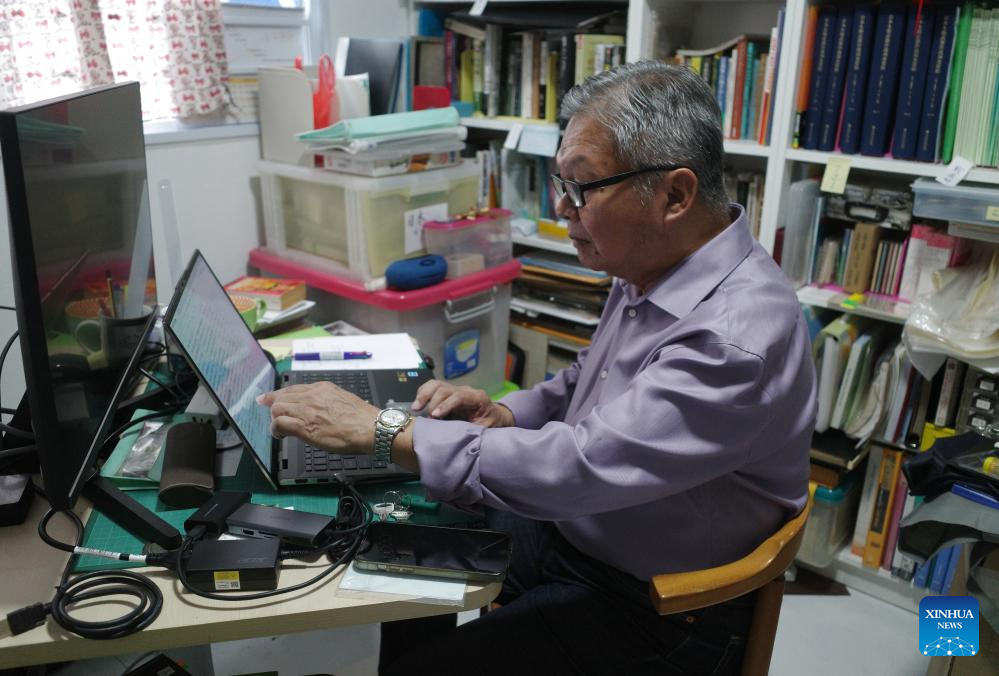
Singaporean scholar Lim Shao Bin checks copies of archival materials at his home in Singapore on Aug. 23, 2025.(Xinhua/Shu Chang)
SINGAPORE/TOKYO, Aug. 27 (Xinhua) -- To facilitate its aggression in the Pacific theater, the Japanese Imperial Army in WWII began deploying a biowarfare troop in Southeast Asia in March 1942, similar to the notorious Unit 731 in northeastern China.
Outside academia, little was known about the secretive unit. Recently, a collection of historical records compiled by Singaporean and Chinese scholars, "Oka 9420 Unit, Japanese South Army BW Troop," brings together nearly a decade of archival digging, revealing Japan's wartime inhumane atrocity to the public.
"The deeper we probe, the more we confront the darkness of Japanese militarism -- horrifying, filthy, and toxic," said Lim Shao Bin, the collection's Singaporean author.
THE TOP BIOWARFARE UNIT OUTSIDE CHINA
In May 1942, a biowarfare unit was formed in Nanjing, China, and was dispatched to Singapore a month later. The detachment, publicly known as the Epidemic Prevention and Water Purification Department of the Southern Expeditionary Army Group, was referred to as the Oka 9420 Unit (Unit 9420) within the Japanese Imperial Army, according to historical records.
The Singapore-based biowarfare unit crept into what are today Malaysia, Indonesia, the Philippines, Thailand, Vietnam, and Myanmar, according Lim and Wang Xuan, Chinese co-author of the collection.
Records show one of its central missions was raising rats and cultivating plague-infected fleas.
Othman Wok, a late Singaporean minister, recalled how he had worked as an assistant in the unit. In his oral history done in 1981, Wok said that the unit's daily tasks were to capture rats and feed fleas with rat blood and flesh infected with plague bacteria. "Once in every three to four months," he said, "millions of these fleas were taken alive in big glass jars to Thailand by train."
According to Lim's probe, Unit 9420's core members were from established biowarfare units like Unit 731 in China's Harbin, other units in Nanjing and Japanese homeland. At its height, the unit had more than 1,000 personnel, making it the largest biowarfare force beyond the Chinese theater.
A former member of Unit 9420, Ryomei Taikai, recalled raising rats at a school in Kuala Pilah in the central Malay Peninsula, and transporting numerous rats from Japan. "In the bomber's cargo hold," he said, "the cages (containing rats) were stacked like a mountain."
Lim and Wang have also delved into traces of human experimentation in Southeast Asia within Unit 9420 and beyond.
War criminal records at the British National Archives showed four Japanese soldiers poisoning prisoners in today's Malaysia to observe their deaths. The National Archives of Australia detailed how Japanese officers in Papua New Guinea subjected 13 prisoners of war to a 60-day starvation and anti-malaria experiment, and six of them died.
WHERE DID THE FLEAS GO
Nearly a decade of research has raised new questions. Among them is that where the plague fleas were ultimately released.
The evidence points toward Burma, today's Myanmar, Lim said.
In a postwar letter, U.S. physician Leonard Short at the Joint Intelligence Collective Agency noted the Japanese might have produced plague fleas in Yangon. In early 1944, he wrote, the American Chemical Warfare division alerted intelligence agencies that "the Japanese were distributing 'Christmas ball' containers, by air, in a regular pattern on the border of Burma-China." The "Christmas ball" was similar to Unit 731's glass-shelled bacteria bomb.
Declassified U.S. National Archives documents recorded that in 1944, "Japanese required Burmese to furnish live rats and mice. Army speculates Japanese may use them in biological warfare to spread plague."
Despite existing findings, a lack of firsthand information poses a big challenge to grasping the picture of the entire Japanese wartime biowarfare system, said Lv Jing, an associate professor of Chinese history at Nanjing University.
Kyoichi Takebana, a member of the Malay branch of Unit 9420, recalled that when dozens of unit members fled to Laos in 1945, they burned large caches of records upon knowing Japan's surrender.
Lim relied heavily on the Japan Center for Asian Historical Records, copying and backing up key files out of concern that they might one day become inaccessible.
Fumio Hara, a researcher of Unit 731 and a member of Japan's Research Society for War and Medicine, said he had requested rosters of epidemic prevention and water purification units held by the Japanese government, but the documents he received had been heavily redacted, with "personal information" cited as the reason. Some records that were once publicly available, he added, have been closed.
URGENCY OF REVEALING TRUTH
On Aug. 15, 1945, Japan declared its unconditional surrender. In the years that followed, U.S. military probed into its wartime atrocities.
Yet the U.S. probe soon gave way to a cover-up. Discreetly, investigators granted those involved immunity in exchange for research data gained by the Japanese biological warfare units. Many perpetrators of barbaric experiments and biological attacks later practiced civilian medicine, some of whom even became respected doctors.
Eyewitness accounts surfaced only sporadically and drew little attention. It was not until 1981, with Seiichi Morimura's book "The Devil's Gluttony," that the horrors of Unit 731 were brought to public.
"Many people are unaware that aside from brutal killings, Japanese military expansion was often carried out in the guise of so-called health and technical assistance," said Lv. "We need to restore facts and be truthful about the nature of Japanese aggression so that future generations will not repeat past mistakes."
"The Japanese government, while acknowledging the existence of Unit 731, denies any evidence of human experiments or biological warfare. Even less, Japanese society has yet to thoroughly reflect on the true causes of the war," said Hara.
He warned of the urgency of revealing historical truth, given that "in recent years Japan had been pushing for massive military build-up."
For Hara, the lesson is clear. "We, the Japanese, need to squarely face the truth and learn from it -- this is an undeniable historical task for peacekeeping." ■