




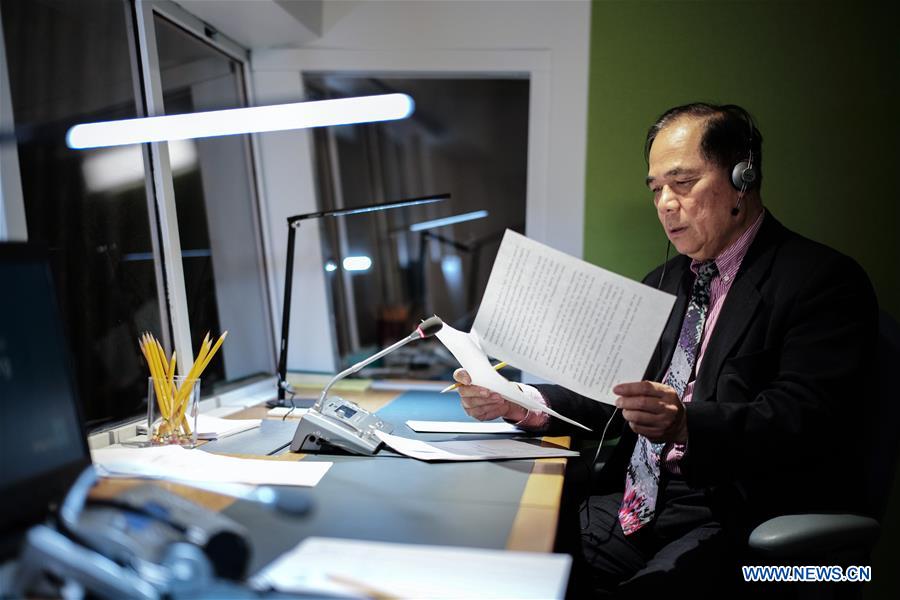
Chen Feng, currently a senior simultaneous interpreter at the United Nations headquarters, is pictured inside the Security Council interpretation booth at the UN headquarters in New York, May 23, 2018. As a member of China's first generation of professionally-trained simultaneous interpreters, he has served as the last English interpreter for Deng Xiaoping, the late Chinese leader widely regarded as the "Chief Architect of China's reform and opening-up." "I'm very fortunate to have been a beneficiary, participant of and witness to China's reform and opening-up policy over the past four decades," said Chen Feng. (Xinhua/Li Muzi)
by Xinhua writers Ma Jianguo, Joshua Vizer
UNITED NATIONS, June 5 (Xinhua) -- "I'm very fortunate to have been a beneficiary, participant of and witness to China's reform and opening-up policy over the past four decades," said Chen Feng, currently a senior simultaneous interpreter at the United Nations (UN) headquarters.
As a member of China's first generation of professionally-trained simultaneous interpreters, he has served as the last English interpreter for Deng Xiaoping, the late Chinese leader widely regarded as the "Chief Architect of China's reform and opening-up."
"CROSSING THE RIVER BY GROPING FOR STONES"
In a recent interview with Xinhua, Chen said he was an English lover though the language was not valued when China was closed to the foreign world.
He read English novels during work breaks and tried to catch up with English lessons via a short-wave radio. His passion, coupled with professional training for simultaneous interpreters introduced by the United Nations to China in 1979, led him to an unexpected career.
In 1981, he went to Beijing for a postgraduate course jointly organized by the United Nations and China's Ministry of Foreign Affairs and Ministry of Education.
"To tell you the truth, even many of our teachers had not heard of simultaneous interpretation as a term" at that time, Chen said.
Chen was in the second batch of students admitted to the United Nations Interpreters/Translators Training Course. His classmates included present Chinese Consul General in New York Zhang Qiyue and China's former permanent representative to the United Nations Liu Jieyi.
After graduation, Chen, an educated Cantonese, served as an interpreter for Chinese ambassadors in London and later was chosen to work for Deng.
Chen said that Deng spoke with a strong Sichuan accent using words or phrases that were very innovative and groundbreaking. He often put forward new ideas in idiomatic colloquial terms that were a challenge both for immediate comprehension and exact interpreting.
Chen still remembers vividly the great pressure and awe an interpreter faced working with Deng -- every single word uttered by the leader was very important and could not be misunderstood by visiting foreign guests.
It was a time when Deng's famous phrase describing reform and opening-up "crossing the river by groping for stones" became a famous quotation, among other impromptu remarks.
At the beginning of the reform and opening-up period, many Western leaders had doubts about China's policies and wanted to verify them through Deng.
Chen recalled Deng's meeting with then Canadian Prime Minister Pierre Trudeau in July 1990, the last time he interpreted for Deng.
Chen said that during the conversation in the Great Hall of the People in Beijing, Trudeau asked, "Has China considered relaxing its immigration policy?" Deng responded bluntly, "We can open it wide. I'll give you 10 million people. Would you take them?" Trudeau was stunned at this counter-question as the Canadian population then was only 30 million.
PROUD OF CHINA'S GROWING INFLUENCE
Having served in the United Nations for more than 27 years, Chen still remembers the first time when he went abroad.
It was in 1983, 12 years after the Chinese government regained its legitimate seat in the International Labor Organization, that a delegation led by then Minister of Labor and Personnel Zhao Shouyi arrived in Geneva.
Chen was among them, interning before graduation.
The stipend per person per day was only two Swiss francs (about two U.S. dollars at that time), with which he could only buy some BIC ballpoint pens. The small exotic "modern" gifts pleased his fellow students and friends at home.
Nowadays, most "foreign" gifts he plans for Chinese friends and relatives can be found in malls and supermarkets in China, or at least at airport duty free shops. Additionally, many are already made in China.
He said the change over the past 40 years is a remarkable turnaround.
Recalling the experience of taking his children to Europe 20 years ago and sitting on the Eurostar train, he said that it was a big surprise that after only 20 years, China could produce its own high-speed trains that are much better and faster than Eurostar.
Chen, who lives in Queens, New York, often goes to work by subway, which usually cost him over 50 minutes from his residence to the United Nations. Commenting on the old trains, Chen shook his head and said, "It's incredible. In Guangzhou, Shanghai or Beijing, the same distance takes less than 20 minutes."
Since the beginning of his work at the United Nations in 1991, Chen has witnessed tremendous changes relating to China within the organization.
He said what impressed him most was the change in United Nations membership fees, which are based primarily on a country's share of the world's gross domestic product. In the 1990s, China's dues were about 0.79 percent of the total.
Today, China's membership dues have risen to around 7.9 percent of the total UN budget, a 10-fold rise since 1991.
China currently ranks third in membership contributions, behind the United States and Japan.
Mentioning terms such as "a community of shared future for mankind," "the Belt and Road Initiative" and "green development" that originated in China's own development, Chen said some Chinese concepts and initiatives have been incorporated in UN documents and strategies and have already become popular concepts in global governance.
What's more, the China-proposed concept of "common but differentiated responsibilities" between developed and developing countries is now one of the major UN principles for environmental issues, Chen said.
