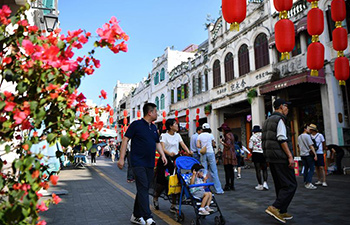
ANKARA, Feb. 11 (Xinhua) -- Crowds queued in front of a municipality tent for their turn to purchase cheap vegetables in Turkey's capital Ankara.
Retired elderly men and women in central Kurtulus district fulfilled their bags with onions, tomatoes and peppers almost in half prices compared to shops, because it's a direct selling stand of Ankara municipality for customers.
"No more swindler sellers any more. Can you believe that price of green pepper is 16 Turkish liras (3 U.S. dollars) at the market and here it is 6 liras," Ahmet Yahsi, 64 years old, told Xinhua.
Direct selling points of the municipalities are the latest move of the Turkish government in an effort to curb the prices of vegetables and fruits, the inflation rate of which hit almost a 20-year high.
Municipalities in Istanbul and Ankara have begun to sell cheaper fruits and vegetables directly to consumers on Monday with almost half prices of the market. A person is allowed to buy a maximum of three kilos of goods.
Safi Nallioglu, vendor in the same district, said that this is only a "palliative solution" to the hiking food prices.
"One has to ask why the state can not practice successful policies on agriculture," he said.
Turkish President Recep Tayyip Erdogan on Monday pledged to take further measures.
"In recent days ... eggplant, tomato, potato, cucumber's prices began to escalate," Erdogan spoke at an opening ceremony,adding "this was an attempt to terrorize (society)."
According to the Turkey Statistical Institute data, the increase in food prices, both on an annual and monthly basis, was higher than general inflation in the end of 2018.
Last year, the general inflation rose by 20.3 percent, while food inflation rose by 25.11 percent. The highest price hike was for onions with 184 percent. Tomato paste followed with 91 percent, and potatoes with 75 percent.
Moreover, in January, food prices increased by 6.43 percent from a previous month, the highest of the past 20 years, making 31 percent surge in annual food prices.
Turkey's Finance and Treasury Minister Berat Albayrak said latest information suggested that something intriguing has been going on.
"We will take necessary measures. Our citizens will see that any problem could be resolved if the state steps in," Albayrak added.
Last week, Turkish Trade Minister Ruhsar Pekcan said that they had carried out inspection at vegetable and fruit wholesale markets.
They unveiled that some traders charged excessive prices. Officials also fined another 76 companies some 810,000 liras for selling unregistered products and other irregularities, the minister said.
The agricultural sector in Turkey increasingly became dependent on foreign sources such as diesel, electricity, fertilizer, oilseeds and maize.
Value of lira plumped about 40 percent in 2018. As a result, the cost of the farming based on import has doubled.
Agricultural lands in Turkey have been rapidly shrinking since 2005.
Most recently, the government paved the way for import of onions, tomatoes, wheats, barley, corns and rice to prevent excessive increase in prices in the domestic market, but failed to achieve a concrete solution.
"Food prices cannot be reduced without solving the root causes of agricultural problems," said Ali Ekber Yildirim, columnist of Dunya Newspaper and an expert on agriculture.
Heavy weather conditions in January impacted food prices, he said.
Yildirim added that in production centers of Antalya, Mersin, Izmir and Mugla provinces in southern Turkey, where the greenhouse production are widespread, the products suffered great damage because of extreme rainfall, floods, hoses and storms.
"But the increase in food inflation alone cannot be explained by the disasters in January. For years, there have been chronic problems in agriculture of Turkey," he said.
The real reason for increase in prices is the high input costs in agriculture, the negative impact of climate change on agricultural production, the infrastructure deficiencies in the supply chain from producer to consumer, he added.
Farmers who escaped from production because of the state's decision of importing vegetables and fruits also among the factors in excessive increase in prices, the expert noted.