 ?
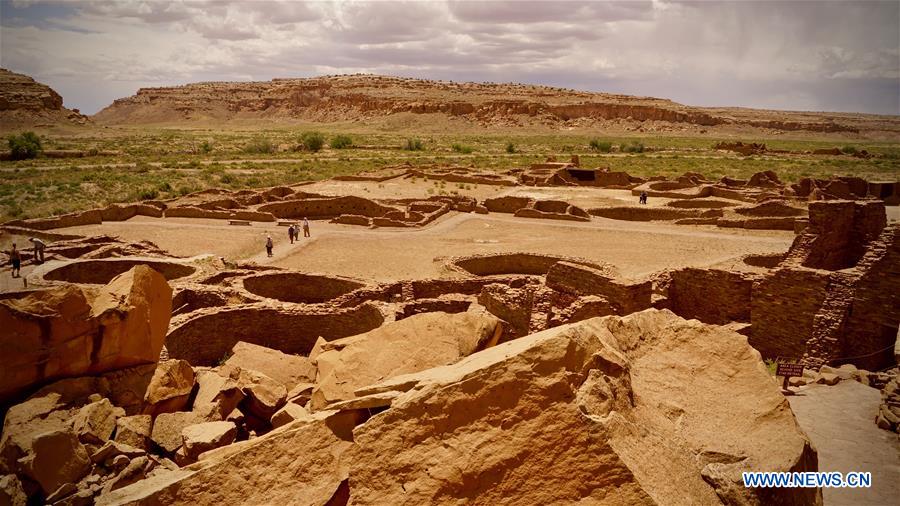
?People visit the Chaco Culture National Historical Park in New Mexico, the United States, on June 15, 2019. In the arid and remote northwest corner of the southwestern U.S. state of New Mexico, lie grand architectures that represent the center of a thriving culture 1,000 years ago. Chaco Culture National Historical Park, known locally as Chaco Canyon, preserves a significant find of pre-Columbian culture that is still being studied by archeologists who are trying to solve the mysteries of its purpose and the reason for its inhospitable desert location. (Xinhua/Richard Lakin)
by Richard Lakin
HOUSTON, June 30 (Xinhua) -- In the arid and remote northwest corner of the southwestern U.S. state of New Mexico, lie grand architectures that represent the center of a thriving culture 1,000 years ago.
Chaco Culture National Historical Park, known locally as Chaco Canyon, preserves a significant find of pre-Columbian culture that is still being studied by archeologists who are trying to solve the mysteries of its purpose and the reason for its inhospitable desert location.
"Chaco Canyon was a high civilization, far beyond anything that anybody had any idea existed here. When they started building the masonry structures, it was a completely different way of shaping space. It's really a new world view," G.B. Cornucopia, the interpretive ranger at the park, told Xinhua.
The cultural flowering of the Chacoan people began in the mid-800s and lasted more than 300 years. Using masonry techniques unique for their time, they constructed massive stone buildings of multiple stories containing hundreds of rooms.
The big questions are: what was its purpose, and why such a desolate location? Despite the enormity of the structures, archeologists have determined that there was never a large population permanently settled there.
Moreover, it could not support a large population because of the scarcity of water, the very cold winters, and the very hot summers. Yet, generations of Chacoan people brought in materials from great distances to build structures that were the biggest in North America until the 19th century.
"They started their civilization in the harshest place in the environment that they had to choose from," Cornucopia said.
Several tribal Pueblo nations still live near the area and there is disagreement among them as to the nature of the Chaco site, ranging from dark and evil to a great shining and enlightened metropolis.
The original inhabitants left no written record of the purpose of their monumental efforts. Like most great indigenous cities in the New World, it was eventually abandoned. Archeologists believe it was due to a severe 50-year drought that began in 1130.
Chaco was once thought to be a northern extension of the Aztec and Mayan civilizations in Mexico, but recently scholars have begun to believe that it developed independently. There is, however, much evidence of contact between Chaco and other Mesoamerican cultures.
Remains of tropical birds kept as pets have been found inside the buildings, which should have been transported from southern Mexico or Central America. A recent discovery of drinking vessels containing traces of chocolate was a major new development to researchers.
"The chocolate was a surprising discovery since the nearest source was 1,200 miles (about 1,931 km) away," said Cornucopia.
Another similarity to the southern pre-Columbian metropolises is the astrological alignment of the structures.
"Most of the buildings are aligned precisely to the cardinal directions, north, south, east, and west. Each one seems to be a piece of a giant puzzle. These are the ways that they tracked time and seasons," explained Cornucopia.
Work continues as archeologists try to solve the mysteries of Chaco Canyon, now a UNESCO World Heritage Site.
"Trying to understand this culture, as to what motivated it and started it and what caused it to occur so large on the landscape, is still a mystery, and we're still trying to figure it out," Cornucopia said.