




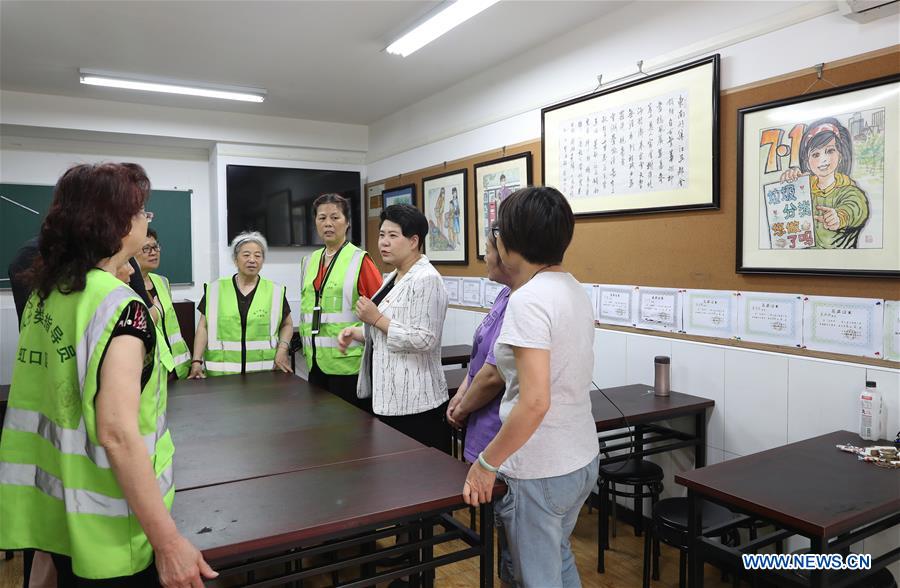
Wang Jinghua, Party branch secretary of a residential community, talks with garbage sorting volunteers in Hongkou District of Shanghai, east China, June 24, 2019. (Xinhua/Fang Zhe)
SHANGHAI, July 3 (Xinhua) -- Starting this week, over 24 million permanent residents in Shanghai face a daily daunting test, and passing it is important.
On Monday, Shanghai entered a new era of compulsory garbage sorting as the country wages war on a growing mountain of garbage to promote green growth and develop a circular economy.
With a set of regulations coming into force, individuals, businesses and institutions in the city are ordered to sort garbage into four separate bins. Anyone who fails to do so could face fines.
NEW RULES
The city is promoting a mandatory garbage sorting system, which requires residents to throw away garbage at a fixed time and place.
For every 300 to 500 households, there is a designated garbage disposal site where volunteers carefully check whether the household waste is accurately classified.
Domestic waste is required to be classified into four categories: dry refuse, wet trash, recyclable waste and hazardous waste. Individuals who fail to sort garbage and decline to rectify can be fined up to 200 yuan (29 U.S. dollars), and businesses and institutions could be fined up to 50,000 yuan.
On Monday, Shanghai issued 623 notices for rectification to institutions and companies who failed to sort their garbage accurately.
"Shanghai will further strengthen supervision of the public environment and strive to eliminate violations of laws and regulations in the process of household garbage sorting," said Deng Jianping, director of the Shanghai Landscaping and City Appearance Administrative Bureau.
Shanghai generates some 26,000 tonnes of garbage per day.
FROM DOUBT TO TRUST
In early June, Zheng Jingwen, a 26-year-old white collar worker in Shanghai, hesitated to order her favorite take-out food. The neighborhood she lived in began to pilot the garbage sorting system, but Zheng had not learned how to classify related waste.
At first, Zheng thought that this was just an empty slogan. She took the unsorted left-overs downstairs, thinking that she could sneak out in the dusk, and got told by volunteers that she did not separate the kitchen waste from dry refuse.
Just like Zheng, many did not believe that this huge city could implement garbage sorting overnight simply. Multiple cities across the country have piloted garbage sorting over the past two decades but failed to achieve ideal results.
Many were skeptical as they had earlier witnessed the garbage trucks dumping and mixing different types of garbage into one container and driving away.
To dispel the distrust, all the garbage trucks in Shanghai are painted with different colors corresponding to different categories of garbage bins. Every citizen can see whether the kitchen waste in the green bins really enters the green trucks. Should the garbage get mixed during transportation, everyone can report it through hotlines or the popular messaging service WeChat.
Still, requiring all residents to bring garbage to fixed spots within two hours every morning and evening is quite a difficult task. Some complain that the time conflicts with the time when they go to and get off work.
"We have prolonged the time to three hours, and there is also a temporary garbage disposal site for those who get off work late. The more we consider the residents' needs, the more they will support us," said Li Juan, Party chief of a residential community in downtown Shanghai.
LEARNING WITH FUN
From durian peels and crab shells to wet tissues and cockroach traps, people often find it confusing when sorting various types of wastes.
"I often get confused. For example, I did not know at first whether the cat litter was wet trash or dry refuse," said Cheng Sijing, a 27-year-old cat owner in Shanghai.
To better prepare the residents for garbage sorting, Shanghai launched a garbage classification inquiry platform on WeChat six months ago.
The number of entries on the platform has increased from 400 to 5,000, with the total number of inquiries exceeding 2 million over the past six months.
Many even bought garbage sorting toys on Taobao, an online marketplace run by Alibaba, to learn about garbage sorting information. One toy consists of four miniature sorting bins with cards representing various types of garbage, with the goal being to sort the garbage in the correct sorting bins.
One residential community in Shanghai's Jiading District ordered several toys for its residents. "We hope to raise children's awareness about garbage sorting," said Xing Minxia, Party chief of the residential community.
Some even played a VR game to learn garbage sorting. "It is simple and easy to understand. Residents can practice garbage sorting knowledge without actually going through the rubbish, and it is also a more effective method than paper materials when training garbage sorting volunteers," said Wu Xia, founder and CEO of VitrellaCore, the company that created the game.
LONG JOURNEY
The promotion of garbage sorting is a long and arduous journey as it takes time for citizens to learn and form a habit and for authorities to improve the facilities.
Currently, the Shanghai Laogang renewable energy utilization center burns 3 million tonnes of domestic waste each year and generates 1.5 billion kWh of power a year.
The city is steadily improving its garbage disposal capacity to turn the sorted waste into resources. Currently, there are eight wet trash resource utilization facilities and eight dry refuse incinerator projects under or about to start construction in Shanghai.
By the end of 2020, the daily disposal capacity of wet trash and dry refuse will increase to 7,000 tonnes and 20,800 tonnes respectively, with basically no domestic garbage be landfilled, according to Deng.
More cities are on their way. China is building household garbage processing systems in 46 pilot cities, including Beijing, Tianjin and Chongqing, and a further 21.3 billion yuan will be invested in these facilities, according to China's Ministry of Housing and Urban-Rural Development.
By 2025, all Chinese cities at or above the prefecture level, totaling more than 300, shall complete the building of garbage sorting and processing systems, according to an official circular issued last month.
(Video reporters: Li Haiwei, Zhang Mengjie, Zheng Juntian; Video editor: Zheng Xing)
