



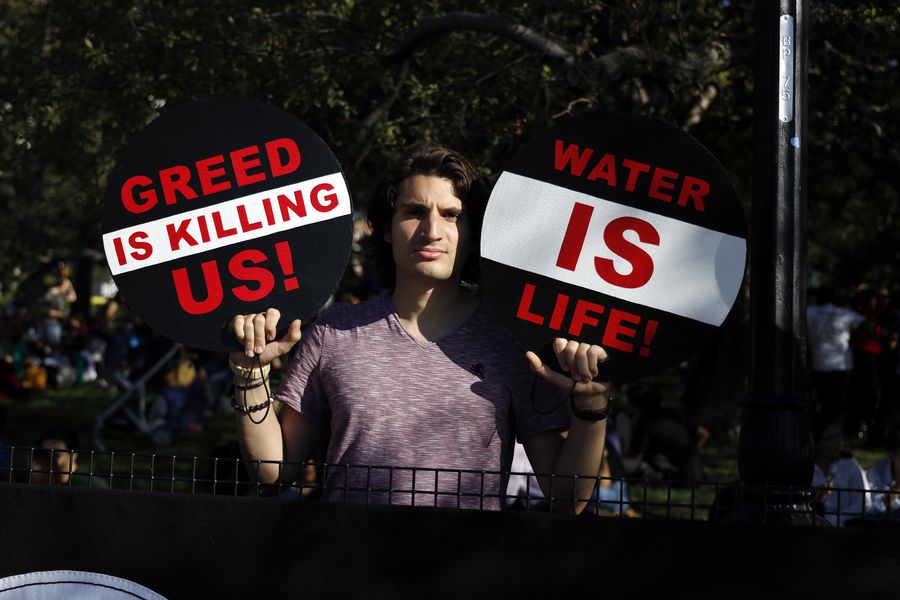
A man participates in a strike to call attention to climate change in New York, the United States, on Sept. 20, 2019. (Xinhua/Li Muzi)
The U.S. government has responded to global climate change challenges by comprehensively rolling back its environment policies.
WASHINGTON, Dec. 21 (Xinhua) -- The year of 2019 is one of climate change. It saw the hottest June and July on record, dwindling sea-ice coverage, and more frequent extreme weather.
However, the U.S. administration responded this global challenge by comprehensively rolling back its environment policies.
On Thursday, U.S. influential magazine Science named U.S. moves to get things backwards in tackling climate change as a breakdown of the year. The U.S. government has forged ahead with a range of policies that make it more difficult for the United States and the world to curb emissions of greenhouse gases.
It came as a rising proportion of Americans believes climate change is real, humans are contributing, and government is responsible to make a difference.
A Pew Research Center survey showed that 57 percent of Americans now considered climate change a "major threat" to the country, up from about 40 percent in 2013. But public opinions did not translate into political actions.
"To really deliver on our climate goals, we do need strong federal action," said Rachel Cleetus of the Union of Concerned Scientists.
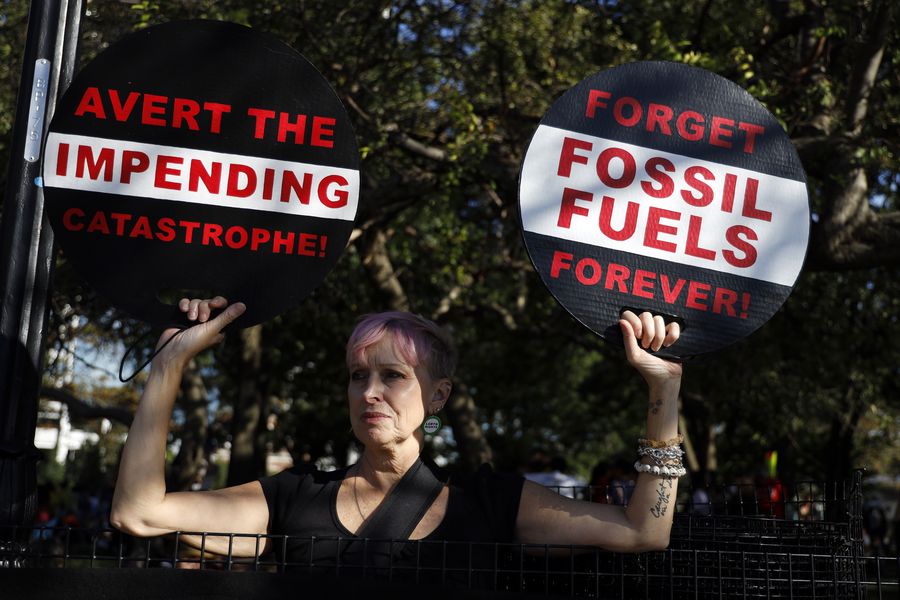
A woman participates in a strike to call attention to climate change in New York, the United States, on Sept. 20, 2019. (Xinhua/Li Muzi)
Researchers from Harvard University Law School who tracked environmental regulatory rollbacks of the current U.S. administration found a total of 66 rules have been scrapped or relaxed since September 2017.
A similar tracking effort by Columbia University Law School showed that the administration and Congress scaled back or wholly eliminated 132 federal climate mitigation and adaptation measures.
A landmark move is that the United States submitted formal notification of its withdrawal from the Paris Agreement on Nov. 4, making it the only nation among nearly 200 signatories that abandoned this global agenda on combating climate change.
The U.S. government brook no delay since that is the earliest date it can apply for quitting. It is "incredibly short-sighted," as Nature Conservancy, an environmental organization in the United States, put it.
On Nov. 5, a global team of over 11,000 scientists from more than 150 countries declared a climate emergency and warned the catastrophic threat if humanity failed to address the climate crisis.
Deke Arndt, chief of climate monitoring for the National Oceanic and Atmospheric Administration (NOAA), said at a conference call that July of 2019 was in the vicinity of a record without a strong El Nino being present, so it was "almost entirely due to climate change."
The U.S. Environmental Protection Agency (EPA) proposed in August to loosen emission control of methane, one of the greenhouse gases that resulted in global warming, by abandoning federal regulations that require the oil and gas industry to install technology that monitors and curbs methane leaks in wells, pipelines and other operational facilities.
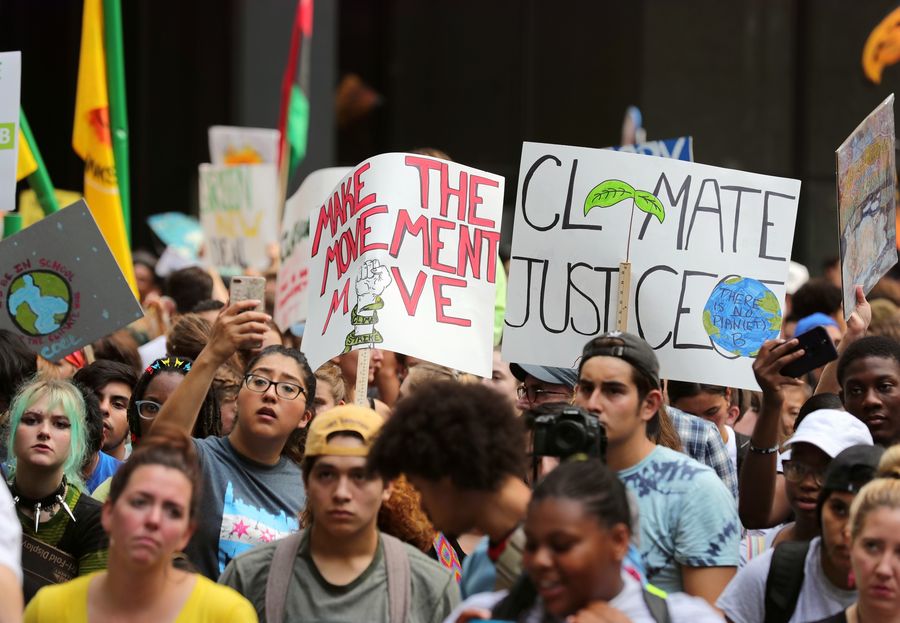
People participate in a strike to call attention to climate change in Chicago, the United States, on Sept. 20, 2019. (Xinhua/Wang Ping)
A team of researchers led by the University of Michigan found unexpectedly that emissions over five major cities along the East Coast are twice the EPA estimate for methane and almost 10 times the estimate for natural gas.
Moves giving favors to heavy-pollution industries but causing damages to the environment also went to EPA's decision in June to overturn the Obama-era attempt to restrict emissions from coal plants by relying more on cleaner fuels.
EPA's replacement rule, Affordable Clean Energy (ACE), allows U.S. states to make their own decisions on ways and timetables to cut emissions, demanding much smaller carbon reductions, which is part of President Donald Trump's pledge to revitalize the country's coal industry.
Actually, by EPA's own estimate in 2018, the ACE is expected to increase emissions of carbon dioxide and the level of emissions of certain pollutants in the atmosphere, which would result in 470 to 1,400 additional premature deaths and up to 96,000 new cases of exacerbated asthma annually by 2030.
"This rule is yet another example of the Trump Administration pandering to fossil fuel industry interests at the expense of human health and the environment," said Attorney General Bob Ferguson of the U.S. state of Washington.
Washington is among a coalition of 22 U.S. states and seven local governments that sued the Trump administration over its decision to relax restrictions on coal-fired power plants.
However, the efforts at the country's local levels to reduce carbon emissions were sometimes cracked down. On Sept. 18, Trump announced that the U.S. government is revoking California's authority to set stricter auto emissions rules.
"By revoking that authority, the administration is eliminating a tool that is reducing emissions, improving vehicle mileage standards and saving consumers 460 billion U.S. dollars at the pump," said California Senator Dianne Feinstein.
Even the auto industry itself viewed the original stricter standards as a key tool in fighting climate change, especially because transportation is now the largest source of carbon dioxide emissions in the United States.
The regulatory rollback is all-encompassing. EPA proposed in November to loosen regulations on how coal-fired power plants in the country dispose of waste laden with heavy metals like arsenic, lead and mercury.
The U.S. government also rolled back in the enforcement of a law to protect endangered species, clearing the way for new mining, oil and gas drilling in areas where protected species live.
"Threatened and endangered fish, wildlife and plants in our national parks already face habitat changes and impacts of a climate crisis that is accelerating every year," said Bart Melton, Wildlife Program Director of National Parks Conservation Association.
A study showed an almost 30 percent drop in the number of North American birds since 1970, due to habitat losses and ecosystems under stress from pollution, climate change, and development. The bird count dwindling is listed as another breakdown of the year on Science magazine. ■
