



It is hoped that the first year of this new decade will be marked by greater political stability, economic prosperity and fruitful trade ties in Latin America, though observers admit it may sometimes be an uphill battle.
by Xinhua writers Cui Yuanlei, Yang Chunxue, Shooka Shemirani
MEXICO CITY, Jan. 20 (Xinhua) -- The year of 2019 was a turbulent one for Latin America where there were protests, violent clashes and a fierce tug of war between conservative and progressive currents in countries long considered bastions of stability.
As the region staggers into 2020 with stagnant or even shrinking growth, hopes are that the first year of this new decade will be marked by greater political stability, economic prosperity and fruitful trade ties, though observers admit it may sometimes be an uphill battle.
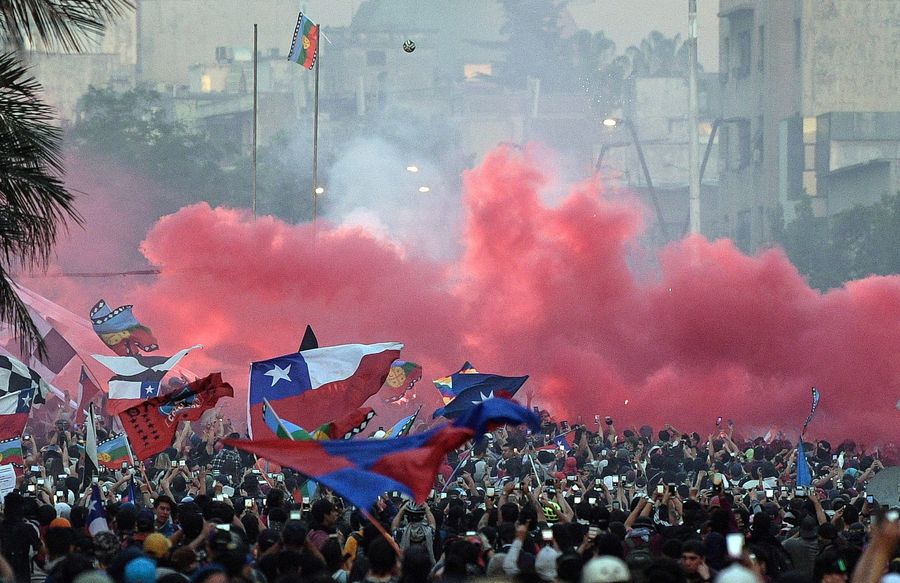
People participate in a protest in Santiago, Chile, Nov. 8, 2019. (Xinhua/Jorge Villegas)
RECOVERING STABILITY
With tensions in the region expected to ease in the new year, Chile and Bolivia, the two most roiled by political upheaval in 2019, have already set the wheels in motion towards recovering stability.
Chileans will get to vote in an April 26 plebiscite on whether to rewrite the Constitution to better address economic and social disparities.
The plebiscite was proposed after massive protests broke out in mid-October against a hike in subway fares in the capital Santiago, and quickly spread throughout the country, fueled by anger at Chile's inability to distribute the country's wealth, which is leading to growing inequality.
It remains to be seen whether the April poll will satisfy Chilean protesters, but one good sign is that the plebiscite addresses what many experts believe is Latin America's biggest concern -- inequality.
It's not enough to generate wealth, as events in Chile, which has emerged as a high-income country in recent years, have proven.
What is needed are policies that promote social and work place inclusion to help eradicate poverty and strengthen the middle class, the United Nations Economic Commission for Latin America and the Caribbean (ECLAC) recommends.

Protesters confront the police in Quito, Ecuador, on Oct. 9, 2019. (Str/Xinhua)
"We have a highly vulnerable middle class, and that is where we have to offer the right answers, especially to the youth," Alicia Barcena, the ECLAC's executive secretary, has said.
Bolivia is set to hold general elections in May for the second time in eight months, after the outcome of October elections was not recognized by the conservative opposition, leading to protests, the resignation of the country's first indigenous president and the installation of an interim government.
Will new elections help pacify the polarized country? That all depends on the turnout, said Bolivian political scientist Marcelo Arequipa.
"Without a doubt, Bolivia's political-electoral horizon seems uncertain, especially since the right insists on a fragmented roster of potential presidential candidates," said Arequipa.
The problem that plagues the right, center-right and hard-right, he said, is the lack of consensus around a unifying candidate, which means those parties will be disputing 60 percent of the votes, while the remaining 40 percent will go to the ruling Movement Towards Socialism (MAS) party.
To win, a candidate must garner more than 50 percent of the vote, or more than 40 percent with a 10-point lead over the runner-up, otherwise a runoff will be held between the two leading candidates.

Jeanine Anez (C) wears the presidential sash after proclaiming herself interim president in La Paz, Bolivia, on Nov. 12, 2019. (Photo by Meagan Hancock/Xinhua)
ECONOMIES REBOUND?
Economic deceleration was widespread and synchronized among Latin American countries and sectors, but several are seeing light at the end of the tunnel.
Brazil, the region's largest economy, has been showing signs of recovery since the second half of last year, with many economic indicators presenting positive results.
On that news, the Brazilian government upgraded its 2020 economic growth forecast in mid-January from 2.32 percent to 2.4 percent.
According to a report by the Brazilian Economy Ministry's Economic Policy Secretariat, economic indicators are coming in stronger than the market expected, especially in certain sectors, such as services, commerce and civil construction.
The region's number two economy, Mexico, breathed a sigh of relief with the approval by the U.S. Senate of the United States-Mexico-Canada Agreement on free trade.
The deal still needs to be passed by Canada's parliament before it can take effect, but it is already helping to lift spirits and confidence in Mexico's economic outlook.
Affected mainly by global trade tensions and social turmoil at home, Chile's exports fell 7.4 percent in 2019. But the government is looking to revert those losses this year by expanding both its range of export products and export markets.
"We are looking to diversify our presence in leading markets we are already in, such as China and the United States, for example, by increasing our export of services," said Rodrigo Yanez, Chile's undersecretary for International Economic Relations, told reporters.

Aerial photo taken on Sept. 18, 2019 shows a view of a photovoltaic plant with Chinese technology and equipment in the town of Cafayate, Salta Province, Argentina. (Xinhua/Martin Zabala)
Ecuador, also rocked by protests towards the end of 2019, needs to rein in public spending and rising debt before it can see sustained growth.
Much of the discontent in Ecuador, and other Latin American countries, springs from the 1972-1982 oil boom, which resulted in high levels of corruption and rampant spending and burdened nations with huge debt and imbalanced economies to this day.
"The government has to make public finances sustainable again. That is going to help recover the country's competitiveness," economist Alberto Acosta Burneo told Xinhua.
Protests in Ecuador are sparked by the elimination of fuel subsidies, which resulted in a sudden spike of gasoline prices and was estimated to save the government 1.5 billion U.S. dollars a year to start getting its finances in order.
In a report issued in December, the ECLAC said fiscal policies in the region should be centered "on the reactivation of growth and on responding to growing social demands."
CHINA-LATAM COOPERATION
As an important trade and development partner for Latin America, China is playing a growing role in the region's development, and offers more chances for the region to make continued progress on different fronts, regional observers agreed.
With shared interests in development and highly complementary economies, cooperation between China and Latin American countries has enjoyed sound momentum of growth despite the region's instability and weak economy.

A staff member of the Shijiazhuang Customs checks the quality of a pear for export to Brazil, in the city of Cangzhou, north China's Hebei Province, Jan. 14, 2020. (Xinhua/Mu Yu)
Statistics of China's Ministry of Commerce showed that the two-way trade volume from January to November last year stood at 286.8 billion dollars, with a year-on-year increase of 1.8 percent.
Five years ago, Chinese President Xi Jinping proposed building a China-Latin America community with a shared future, ushering in a new era in China-Latin America ties.
Boosted by the China-proposed Belt and Road Initiative, the two sides have made notable strides in strengthening comprehensive cooperation in many fields from high-level exchanges to trade liberalization.
In the eyes of Latin American experts, the initiative, with an aim to build networks connecting Asia with Europe and Africa and beyond, is generating a lot of interest in a region that has traditionally lacked the infrastructure to promote development.
"China is expected to participate much more actively in the region's economic transformation," said Juan Angel Cordero, a Cuban expert in international relations, noting that China's cooperation with Latin American countries will be multidirectional.
Scholars also called on countries in Latin America to study China's experience in governance and national development.
According to Venezuelan geopolitical expert Luis Quintana, China has come up with a successful formula that has also been applied with positive results in Latin America -- a state that plays an active role in the economy and in promoting social rights, and a private sector that takes active part in the process of national development.
It "has required a progressive and sustained process of reforms and opening up, which have brought China formidable progress," said Quintana.
(Video reporters: Cui Yuanlei, Yang Chunxue; Video editor: Peng Ying)■
